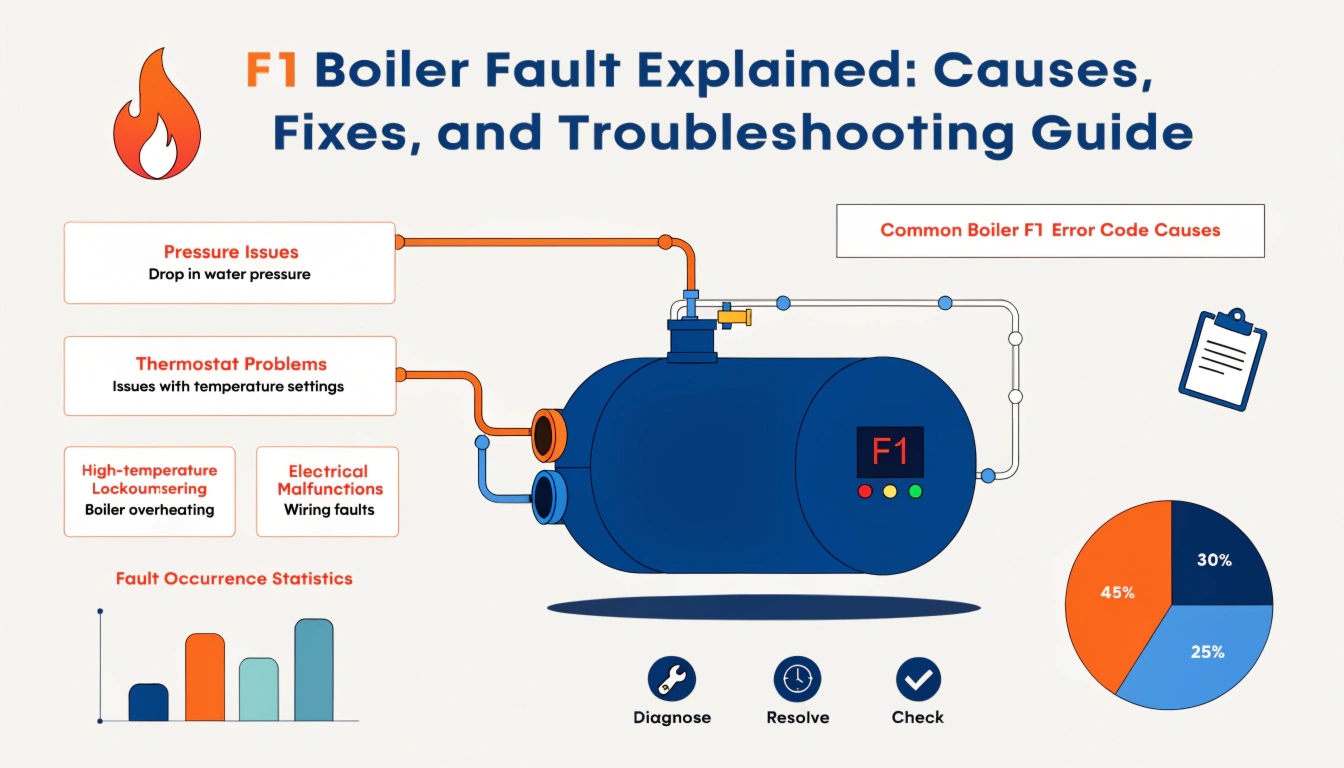
F1 Boiler Fault Explained: Causes, Fixes, and Troubleshooting Guide
Is Your Boiler Showing an F1 Fault Code?
If your boiler is displaying an F1 fault code, you need to act quickly. This error is one of the most common boiler issues homeowners face across London. At London Plumbers and Property Maintenance, we provide expert boiler installation London services alongside trusted repairs and diagnostics. Understanding the F1 fault code can save you time and money. It can also help you decide when to call a professional engineer. This guide walks you through everything you need to know from causes to fixes.
What Is the F1 Boiler Fault Code?
The F1 fault code is a pressure-related error. Most modern combi boilers display this code when the system pressure drops too low. Typically, boilers require a pressure between 1 and 1.5 bar to function correctly.
When pressure falls below this threshold, the boiler shuts down automatically. This is a built-in safety feature to protect the system from damage.
Key facts about the F1 fault:
It indicates low water pressure in the system
It is common in Worcester Bosch, Vaillant, and Ideal boilers
It can occur after bleeding radiators or a system leak
It may appear after extended periods of no use
Common Causes of the F1 Fault Code
Understanding the cause helps you find the right fix. Here are the most frequent reasons your boiler shows an F1 error:
1. Water Leak in the System
A leak anywhere in the system causes pressure to drop. This is the most serious cause. Leaks can occur at radiator valves, pipe joints, or the boiler itself.
Signs of a leak:
Damp patches near pipework for radiators
Water stains on walls or ceilings
A continuously dropping pressure gauge
2. Recently Bled Radiators
Bleeding your radiators releases trapped air. This process also releases a small amount of water. If you bleed multiple radiators, the pressure can drop enough to trigger the F1 code.
3. Faulty Pressure Relief Valve
The pressure relief valve (PRV) releases water when pressure gets too high. A faulty PRV may release water continuously. This causes pressure to drop and the F1 fault to appear.
4. Expansion Vessel Issues
The expansion vessel absorbs pressure changes within the system. If it fails or loses charge, the boiler pressure becomes unstable. This often leads to repeated F1 faults after re-pressurizing.
5. Filling Loop Problems
The filling loop is used to top up the boiler pressure. If it is damaged, blocked, or incorrectly installed, it may not allow water in. This makes it impossible to resolve the low pressure issue.
How to Fix the F1 Boiler Fault: Step-by-Step Guide
Before calling an engineer, try these steps yourself. Always ensure your boiler is switched off before starting.
Step 1 — Check the Pressure Gauge
Locate the pressure gauge on the front of your boiler. The needle should sit between 1 and 1.5 bar. If it reads below 1 bar, low pressure is the problem.
Step 2 — Locate the Filling Loop
The filling loop is usually a silver or grey braided hose. It connects two pipes beneath the boiler. Some boilers have an internal filling key instead.
Step 3 — Re-Pressurize the Boiler
Ensure both valves on the filling loop are closed
Open the first valve slowly until you hear water flowing
Watch the pressure gauge rise steadily
Open the second valve once you are comfortable
Close both valves once the gauge reaches 1.2 bar
Restart the boiler and check the fault has cleared
Important:Never exceed 1.5 bar when re-pressurizing. Over-pressurizing. causes further damage.
Step 4 — Reset the Boiler
Once pressure is restored, press the reset button. Hold it for 3–5 seconds. The boiler should restart and the F1 code should disappear.
Step 5 — Monitor the Pressure
Keep an eye on the pressure over the next 24–48 hours. If the pressure drops again, there may be a leak or a deeper mechanical issue.
When to Call a Professional for Boiler Repair London
Some F1 faults are beyond simple DIY fixes. If any of the following apply, contact a Gas Safe registered engineer immediately. London Plumbers and Property Maintenance offers reliableboiler repair London servicesto resolve these issues safely.
Call a professional if:
Pressure drops repeatedly within a short period
You notice visible water leaks around pipework or the boiler
The pressure gauge moves unusually quickly
You cannot locate the filling loop
The boiler makes unusual noises after re-pressurizing
You are unsure about any step of the process
Attempting to repair gas components without qualifications is dangerous. It is also illegal under UK law. Always trust a Gas Safe registered engineer for any internal boiler work.
Preventing Future F1 Boiler Faults
Prevention is always better than a costly repair call-out. Follow these tips to keep your boiler running efficiently.
Annual boiler servicing is the single most effective preventative measure. Our boiler service London team at London Plumbers and Property Maintenance checks pressure levels, tests the PRV, inspects the expansion vessel, and identifies early signs of wear.
Other preventative tips:
Check your boiler pressure monthly during winter
Bleed radiators carefully and re-pressurise afterwards
Insulate exposed pipes to prevent freezing and pressure drops
Book a service every 12 months with a Gas Safe engineer
Replace an ageing boiler before it becomes unreliable
Is It Time for a New Boiler?
If your boiler is over 10–12 years old and regularly showing F1 faults, replacement may be more cost-effective than repeated repairs. Modern A-rated condensing boilers are far more energy-efficient.
London Plumbers and Property Maintenance specializes in boiler installation London for residential and commercial properties. We supply and install leading brands including Worcester Bosch, Vaillant, and Viessmann. Our engineers are fully Gas Safe registered and provide a manufacturer-backed warranty on every installation.
Frequently Asked Questions (FAQs)
Q1. What does the F1 fault code mean on my boiler?
The F1 fault code indicates that your boiler has low water pressure. This usually means the system pressure has dropped below 1 bar. You can often fix this by re-pressurizing the system via the filling loop.
Q2. How often should I re-pressurize my boiler?
Boiler pressure naturally drops slightly over time. If you need to top it up more than once every few months, there may be an underlying issue. We recommend booking a boiler service to investigate the root cause.
Q3. Can I fix an F1 boiler fault myself?
Yes, in many cases you can re-pressurize the boiler yourself safely. However, if the pressure drops repeatedly, or if you suspect a leak, always contact a Gas Safe registered engineer. London Plumbers and Property Maintenance offers same-day boiler repair across London.
Q4. How much does boiler repair cost in London?
Boiler repair costs in London vary depending on the fault and parts required. A simple re-pressurization visit typically costs less than a component replacement. Regular boiler servicing reduces the likelihood of expensive emergency repairs.
Q5. How do I know if my expansion vessel has failed?
Signs of a failed expansion vessel include pressure that rises very quickly and then releases through the PRV. You may also notice the pressure gauge fluctuating dramatically. A Gas Safe engineer can test and recharge or replace the expansion vessel during a service visit.